
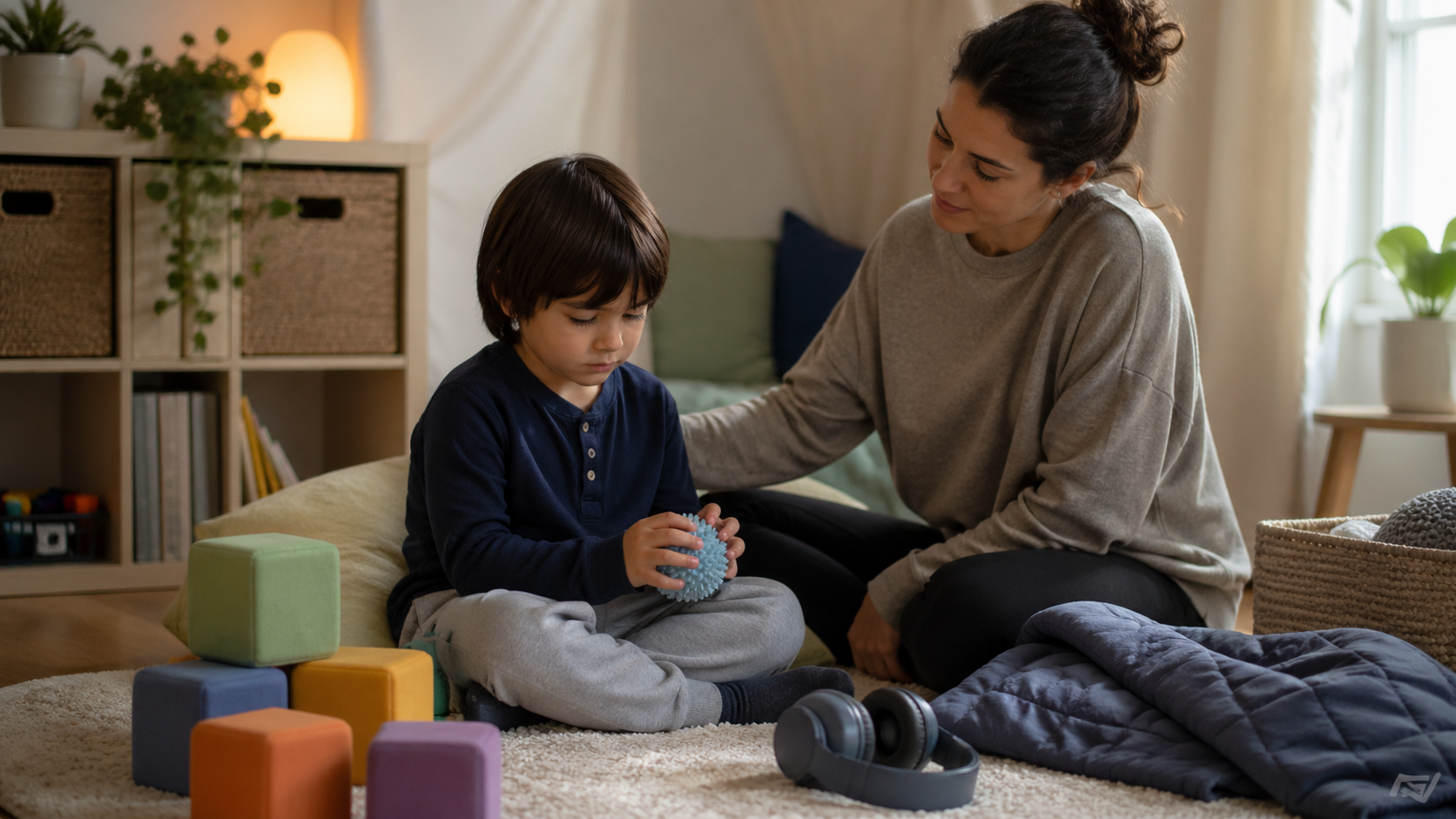
For many parents, sensory processing challenges are one of the first parts of autism that begin to explain daily life. A child who covers their ears in a grocery store, refuses certain clothes, melts down after school, avoids birthday parties, seeks constant movement, or becomes upset by unexpected sounds may not be “overreacting” or “misbehaving.” They may be responding to a world that feels too loud, too bright, too scratchy, too crowded, or too unpredictable.
Sensory processing refers to how the brain notices, organizes, and responds to information from the senses. This includes familiar senses like sound, sight, touch, taste, and smell. It can also include body-based senses such as balance, movement, body awareness, pressure, and internal feelings like hunger, thirst, or needing the bathroom.
For autistic children, sensory experiences can be stronger, weaker, more distracting, more confusing, or harder to filter. This can affect everyday routines, school, family outings, clothing, meals, sleep, play, and emotional regulation.
This guide is not medical advice and is not meant to diagnose a child. It is a parent-friendly starting point for understanding sensory processing challenges and how they may affect daily life.
What Sensory Processing Means
Every child receives sensory information throughout the day. They hear voices, see lights, feel clothing on their skin, smell food, taste different textures, move their body, and adjust to temperature, noise, and space.
For some children, this information is processed smoothly. They may notice a sound or texture and move on. For autistic children, sensory input may be harder to ignore or harder to make sense of.
A sound that seems normal to one person may feel painful or startling to a child with sound sensitivity. A shirt tag may feel unbearable. A crowded room may feel chaotic. A bright classroom may make it harder to concentrate. A child may also seek sensory input by jumping, spinning, climbing, humming, touching objects, or pressing into cushions because their body is looking for more movement, pressure, or feedback.
Sensory processing challenges can affect how a child behaves, communicates, learns, rests, eats, and participates in family life.
What Sensory Challenges Can Look Like in Children
Sensory challenges can look different from child to child. Some children avoid certain sensations. Others seek them out. Some do both, depending on the situation, time of day, or how tired they are.
A child may cover their ears when a blender turns on, avoid public washrooms because of hand dryers, or become distressed in stores with bright lights and background music. Another child may crash into furniture, spin in circles, jump repeatedly, chew on clothing, or constantly touch objects.
Some sensory reactions are easy to recognize. Others are easy to misunderstand.
For example, a child who refuses to wear jeans may not be trying to be difficult. The fabric may feel uncomfortable against their skin. A child who runs away at a family party may not be rude or antisocial. The noise, smells, people, and expectations may be too much. A child who falls apart after school may have spent the whole day coping with sensory demands that were invisible to others.
When parents understand sensory processing, they can begin to look beneath the behavior and ask a more useful question:
What is my child experiencing right now?
That question can change the way families respond.
Hypersensitivity: When Sensory Input Feels Too Strong
Hypersensitivity means a child may experience certain sensory input as too intense, uncomfortable, distracting, or overwhelming.
A child with sound sensitivity may struggle with vacuum cleaners, fire alarms, hand dryers, school bells, barking dogs, loud classrooms, or crowded restaurants. A child with touch sensitivity may dislike certain fabrics, tags, socks, seams, hair brushing, toothbrushing, sunscreen, or messy play. A child sensitive to smell may react strongly to perfumes, food smells, cleaning products, or public spaces.
Visual sensitivity can also matter. Bright lights, flickering screens, busy walls, cluttered rooms, or fast-moving environments may make it harder for a child to focus or stay calm.
Hypersensitivity can sometimes lead to avoidance. A child may refuse an activity, run away, hide, cry, shut down, become irritable, or have a meltdown because their nervous system is overwhelmed.
This is why sensory reactions should not be dismissed as fussiness. For the child, the experience may feel genuinely uncomfortable or unsafe.
Hyposensitivity: When Sensory Input Is Harder to Notice
Hyposensitivity means a child may not notice certain sensory input as strongly as others do. They may need more input to feel alert, organized, or aware of their body.
A child may seem unaware of cold, heat, pain, hunger, or personal space. They may bump into objects, press hard when writing, seek deep pressure, climb constantly, or enjoy strong movement. They may speak loudly without realizing it or seem not to hear someone calling their name in a busy environment.
This does not mean the child is ignoring people on purpose. Their brain may be filtering information differently, or other sensory input may be taking priority.
Hyposensitivity can affect safety, routines, and communication. Parents may need to provide clearer cues, more structure, or safer ways for the child to get the input they are seeking.
Sensory Seeking and Sensory Avoidance
Many autistic children show both sensory seeking and sensory avoidance.
A child may avoid loud places but seek strong movement. They may hate sticky hands but love deep pressure. They may dislike clothing tags but enjoy wrapping tightly in a blanket. They may avoid certain foods because of texture but seek crunchy foods because the sensation feels regulating.
Sensory seeking can include:
- Jumping, spinning, rocking, or climbing
- Chewing on clothing, pencils, or toys
- Pressing into cushions or people
- Liking tight hugs or heavy blankets
- Making repeated sounds
- Watching spinning objects or moving lights
- Touching textured surfaces
Sensory avoidance can include:
- Covering ears
- Avoiding bright rooms
- Refusing certain clothes
- Disliking toothbrushing or haircuts
- Avoiding crowded places
- Being selective about food textures
- Becoming distressed by smells
Neither pattern is automatically good or bad. They are clues about what the child’s body may need or what it may be trying to avoid.
What Sensory Overload Can Look Like
Sensory overload happens when a child has taken in more sensory information than they can manage. It may happen suddenly, but often the stress builds over time.
A parent may notice signs such as:
- Covering ears or eyes
- Hiding under furniture or behind a parent
- Crying or yelling
- Running away from a room or activity
- Refusing to move
- Becoming unusually quiet
- Increased stimming or repetitive movement
- Irritability or panic
- Meltdowns
- Shutdowns
- Difficulty following instructions
- Clinging, pushing away, or trying to escape
A meltdown is not the same as a tantrum. A tantrum is usually connected to wanting something. A meltdown is often a loss of coping capacity. The child is overwhelmed and cannot easily reason, explain, or calm down on demand.
A shutdown can be quieter but still serious. A child may stop speaking, withdraw, become still, avoid eye contact, or seem unreachable. This can also be a sign that the environment or situation has become too much.
The most helpful response is usually calm, simple, and supportive. In the moment, a child may need fewer words, less pressure, more space, a quieter environment, or time to recover.
Common Everyday Sensory Triggers
Sensory triggers are different for every child, but certain situations are commonly difficult.
Grocery stores can be overwhelming because of lights, music, crowds, carts, food smells, long lines, and unexpected noises. Birthday parties can be difficult because of balloons, singing, games, social pressure, and unpredictable movement. School can be demanding because of bells, fluorescent lights, crowded hallways, cafeteria noise, group work, and transitions.
At home, sensory challenges may show up around clothing, bathing, haircuts, toothbrushing, mealtimes, bedtime, screen transitions, or sibling noise.
Some common triggers include:
- Loud or sudden noises
- Bright or flickering lights
- Scratchy clothing or tags
- Sock seams or tight shoes
- Strong smells
- Food textures
- Crowded rooms
- Busy visual environments
- Unexpected touch
- Hair washing or brushing
- Toothbrushing
- Public washrooms
- School assemblies
- Fire drills
- Long car rides
- Changes in routine
The trigger is not always obvious. Sometimes the problem is not one thing, but the total load of the day.
Why Sensory Needs Can Change Day to Day
Parents often ask why a child can handle something one day but not the next. This can be confusing. A child may tolerate a grocery store on Monday but melt down in the same store on Friday. They may wear a certain sweater one week and refuse it the next.
Sensory tolerance can change depending on many factors.
A child may cope differently when they are tired, hungry, sick, anxious, rushed, hot, cold, or emotionally stressed. A difficult school day can reduce their ability to manage noise at home. A poor night’s sleep can make clothing feel more irritating. A busy weekend can make Monday morning harder.
This is sometimes described as a full “sensory cup.” When the cup is already full, even a small extra demand can cause overflow.
For parents, this means sensory support is not about finding one perfect solution. It is about noticing patterns and adjusting when your child’s capacity is lower.
Sensory Challenges and Behavior
Sensory needs often show up as behavior because children may not have the words to explain what is happening.
A child may not say:
“The lights are hurting my eyes.”
They may say:
“I hate this place.”
Or they may cry, run, hide, refuse, scream, or shut down.
A child may not say:
“My body needs pressure and movement.”
They may crash into the couch, climb furniture, or push against a parent.
A child may not say:
“The cafeteria is too loud and I cannot think.”
They may stop eating lunch, avoid school, or become upset before leaving home.
This does not mean parents should ignore unsafe or difficult behavior. It means the response becomes more effective when parents ask what need may be underneath it.
The goal is not to excuse every behavior. The goal is to understand what the child may be communicating and respond in a way that helps.
How Parents Can Support Sensory Needs at Home
Supporting sensory needs at home does not have to be complicated or expensive. Many useful supports are simple changes to routines, environments, and expectations.
Parents can begin by observing what helps the child feel calm, alert, and comfortable. Some children need quiet after school. Some need movement before sitting down. Some need clothing options without tags or seams. Some need advance warning before noisy activities. Some need a calm space where they can recover.
Helpful home supports may include:
- Creating a quiet corner or calm space
- Offering headphones in noisy places
- Choosing softer or more comfortable clothing
- Giving transition warnings
- Using visual schedules
- Reducing background noise during difficult routines
- Allowing movement breaks
- Keeping morning routines predictable
- Offering familiar foods alongside new foods
- Preparing your child before busy outings
- Letting your child bring a comfort item when appropriate
Many sensory supports are low-cost. The most helpful option is usually the one that matches the child’s actual sensory needs, not the most expensive product.
How to Track Sensory Patterns
A simple sensory notes system can help parents understand what is happening.
You do not need a complicated chart. You can write brief notes in your phone or a notebook.
Track things like:
- What happened before the difficult moment?
- Where were you?
- Was it loud, bright, crowded, rushed, or unfamiliar?
- Was your child hungry, tired, sick, or coming from school?
- What helped them recover?
- Did the same situation happen before?
- Was there a pattern around clothing, food, noise, movement, or transitions?
Over time, these notes can reveal patterns. You may learn that your child struggles more after school, before meals, in crowded stores, during transitions, or after several busy days in a row.
This information can also help during school meetings, service planning, or conversations with support providers.
Sensory Awareness at School
Sensory processing can affect school in many ways. A classroom may be noisy, bright, busy, and socially demanding. Children may be expected to sit still, switch activities quickly, eat in a loud cafeteria, line up in crowded hallways, and manage unexpected changes.
For an autistic child, this can take a lot of energy.
Parents may want to ask the school what they notice during the day. Does the child struggle during recess, lunch, gym, assemblies, transitions, or group work? Are there certain times when behavior becomes harder? Does the child need a quieter space, movement break, visual schedule, or support during transitions?
Helpful school conversations can focus on practical questions:
- What sensory situations seem hardest for my child?
- What helps my child settle?
- Are there noisy or crowded times of day that cause stress?
- Can my child access a quieter space when needed?
- How are transitions handled?
- Does my child need support before or after assemblies, fire drills, or gym?
- How will the school communicate sensory concerns to us?
The goal is not to remove every challenge. The goal is to help the child participate with the right supports.
Sensory Needs in Public Places
Public places can be especially difficult because they are unpredictable. Stores, malls, restaurants, public transit, playgrounds, religious services, community events, and family gatherings can include many sensory demands at once.
Parents can often reduce stress by preparing ahead.
Before going out, it may help to explain where you are going, what will happen, how long it may take, and what your child can do if they need a break. Some families bring headphones, sunglasses, snacks, a comfort item, a small sensory tool, or a clear exit plan.
It can also help to choose quieter times of day, keep outings shorter, avoid unnecessary stops, or divide errands when possible.
A successful outing does not always mean staying the whole time. Sometimes success means noticing early signs of overwhelm and leaving before the child reaches a breaking point.
Helping Other People Understand
Relatives, friends, teachers, and other adults may not always understand sensory processing. They may think the child is being picky, dramatic, spoiled, rude, or difficult.
Parents do not need to explain everything in detail, but a simple explanation can help.
You might say:
“Loud places can be overwhelming for him, so we are giving him headphones and breaks.”
Or:
“She is not trying to be rude. The texture of that food is hard for her.”
Or:
“He may need a quiet place during the gathering. That helps him stay regulated.”
This kind of language is practical and respectful. It helps others understand the child without shaming the child.
What Parents Should Remember
Sensory processing challenges are not a character flaw. They are not laziness, manipulation, or bad parenting. They are part of how some autistic children experience the world.
When parents understand sensory needs, they often become better able to prevent overwhelm, respond calmly, and advocate for supports.
The goal is not to make the child tolerate everything. The goal is to help the child feel safe enough to participate, learn, communicate, and enjoy life.
Some children will always need sensory accommodations. Some needs may change over time. Many families find that understanding sensory patterns makes daily life less confusing and less stressful.
Final Thoughts
Sensory processing challenges can affect nearly every part of daily life, from getting dressed in the morning to sitting in a classroom, visiting family, eating meals, going to the store, or falling asleep at night.
For parents, the most important starting point is curiosity. Instead of seeing sensory reactions as misbehavior, look for what your child may be experiencing. Notice the environment. Watch for patterns. Support your child before they become overwhelmed. Help others understand when needed.
Your child is not being difficult because they have sensory needs. They are navigating a world that may feel stronger, louder, brighter, rougher, or more confusing than it does to others.
Understanding that can make home, school, and community life feel more manageable for everyone.